# Function to
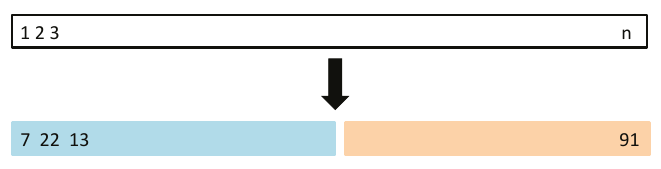
#  1. split the data proportionaly into training and evaluation sample,
#  2. fit the linear model given by formula to training set,
#  3. calculate MSE based on evaluation set.
# in: formula - formula defining relationship among variables,
#     data - data frame to split
#     proportion - numeric value in [0,1] interval, proportion of training sample to the whole set
# out: numeric value of MSE
mse_validset_lm <- function(formula, data, proportion = 1/2, seed = sample(1000,1)) {
  n <- nrow(data)
  set.seed(seed)
  ind <- 1:n %in% sample(n, size = n*proportion)
  train <- data[ind,]
  valid <- data[!ind,]
  fit <- lm(formula, train)
  yname <- names(fit$model)[[1]]
  RSS <- sum((valid[[yname]] - predict(fit, newdata = valid))^2)
  df <- nrow(valid) - length(fit$coefficients)
   RSS / df
}

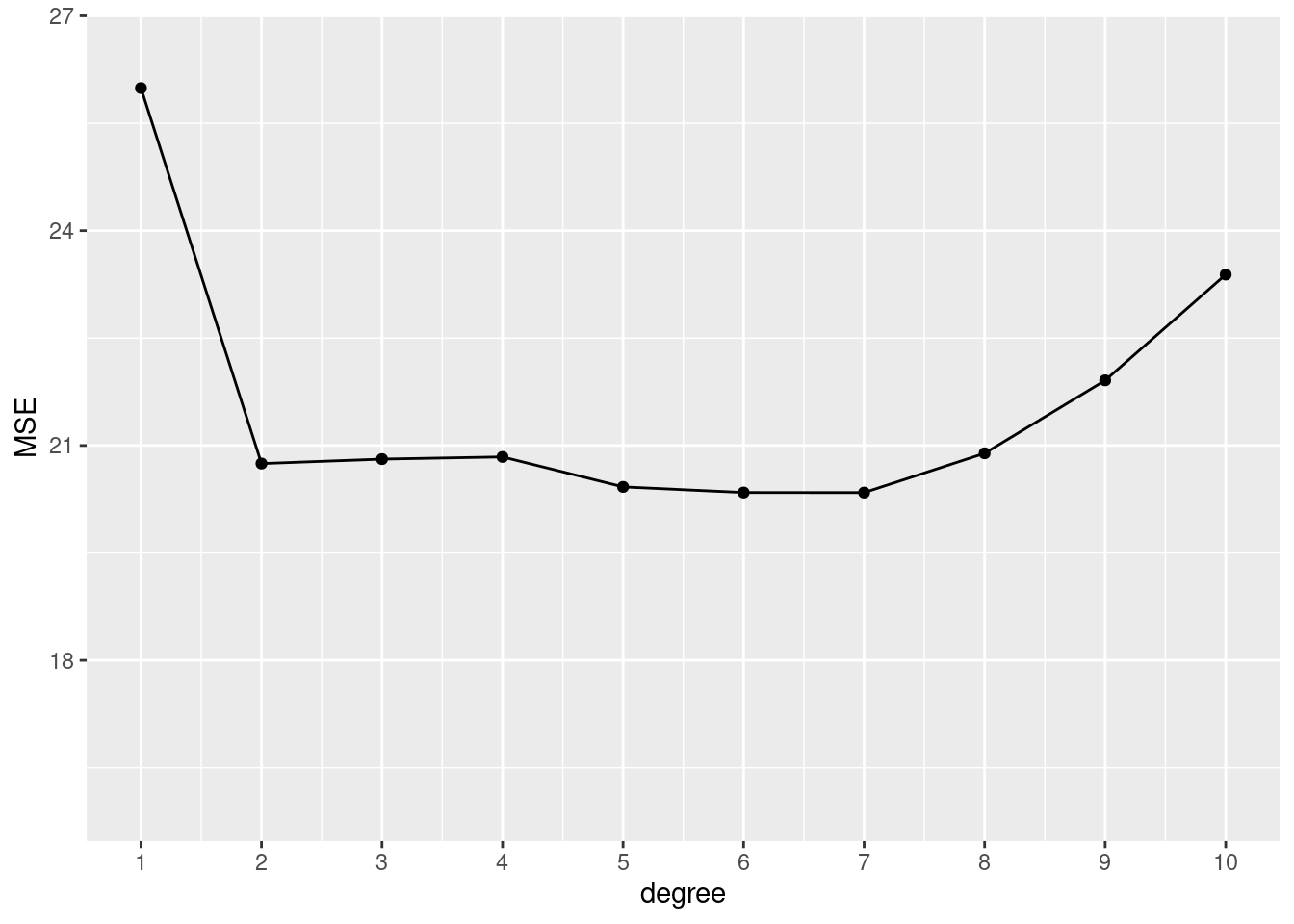
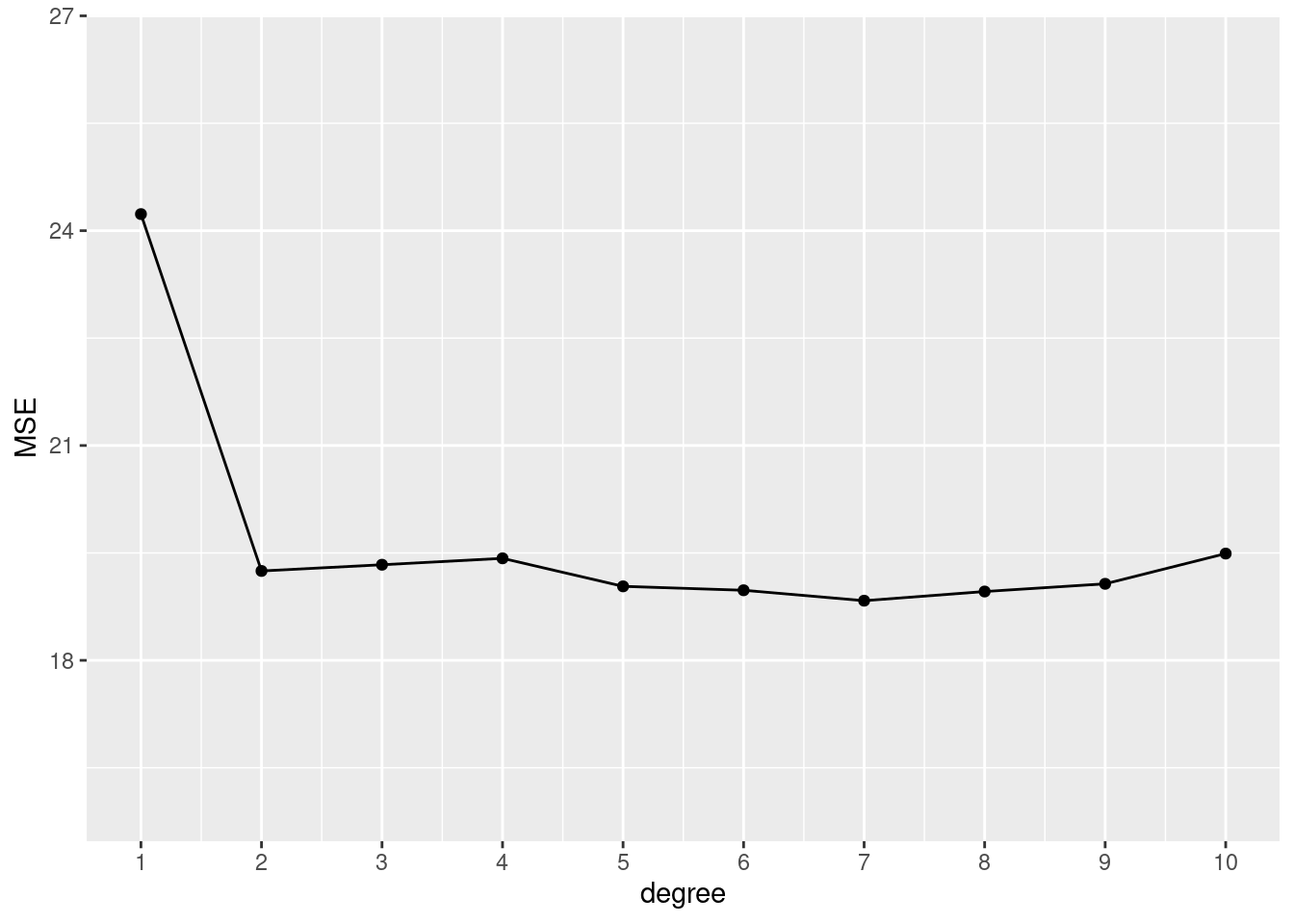
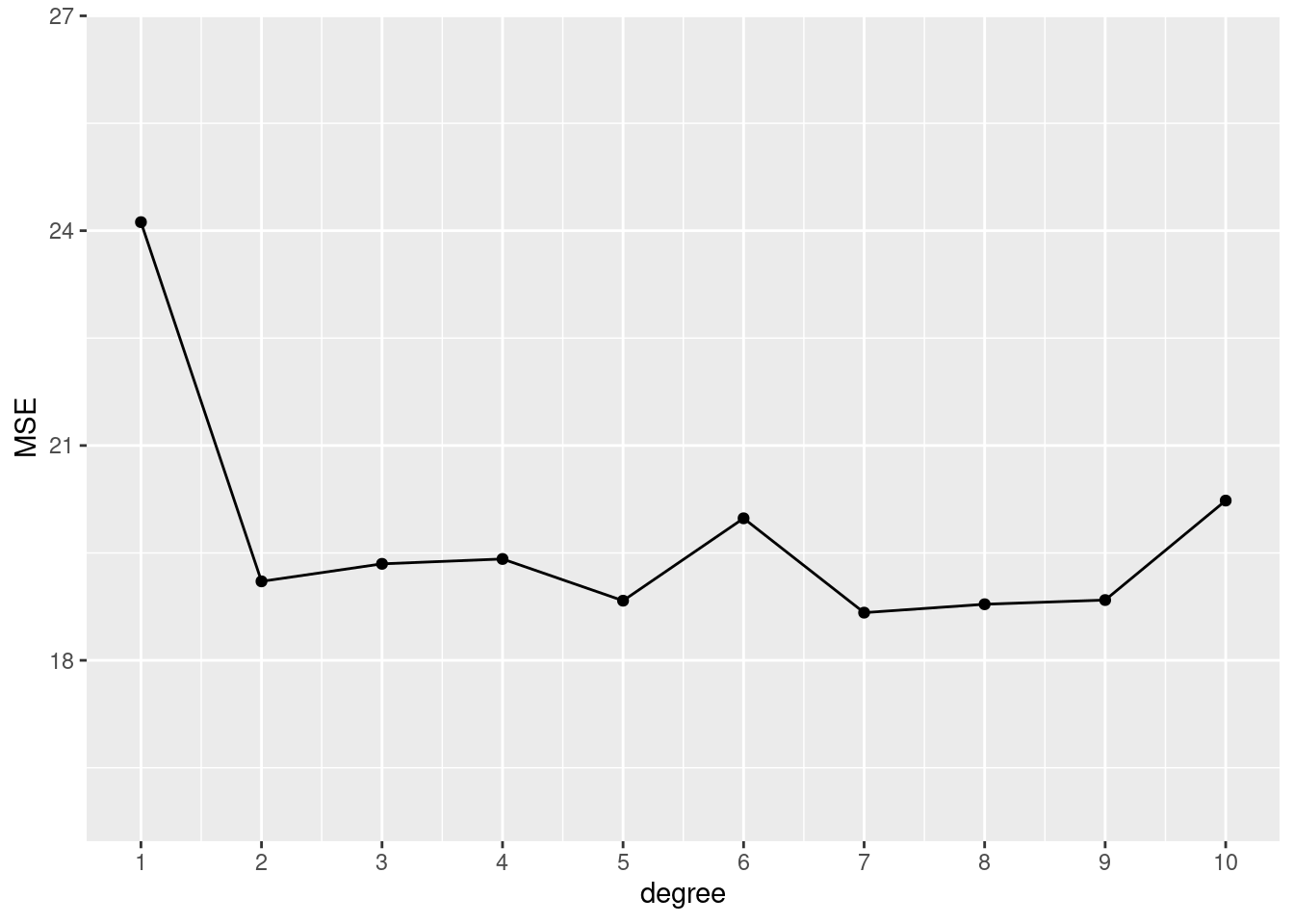
# 1 split, 10 polynomials of certain degrees
tibble::tibble(
  degree = 1:10,
  MSE = sapply(degree, function(x) mse_validset_lm(mpg ~ poly(horsepower, x),
                                                   ISLR2::Auto,
                                                   seed = 2))
) |>
  ggplot() + aes(x = degree, y = MSE) +
  geom_line() + geom_point() +
  scale_x_continuous(n.breaks = 10) +
  ylim(16, 26.5)
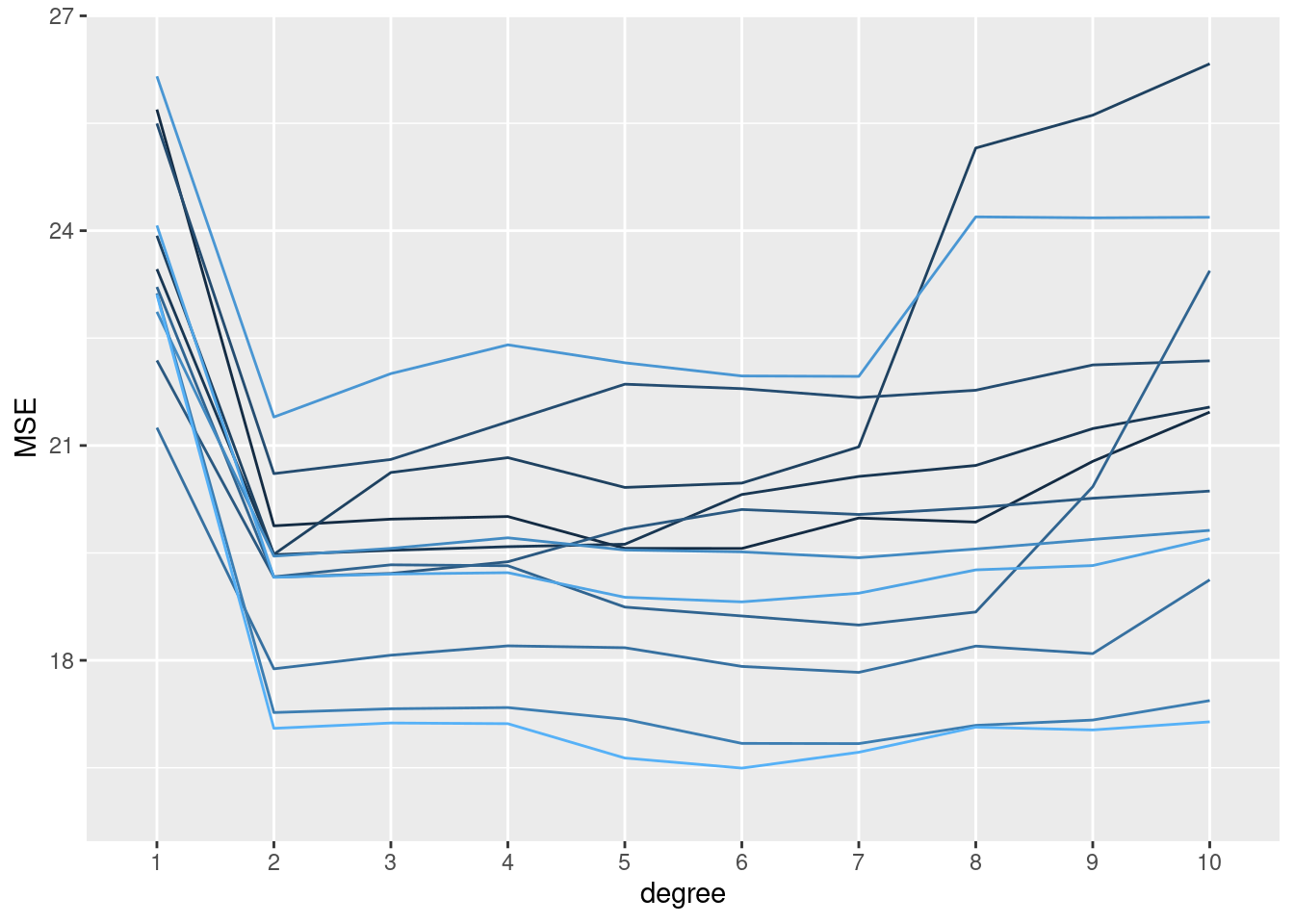
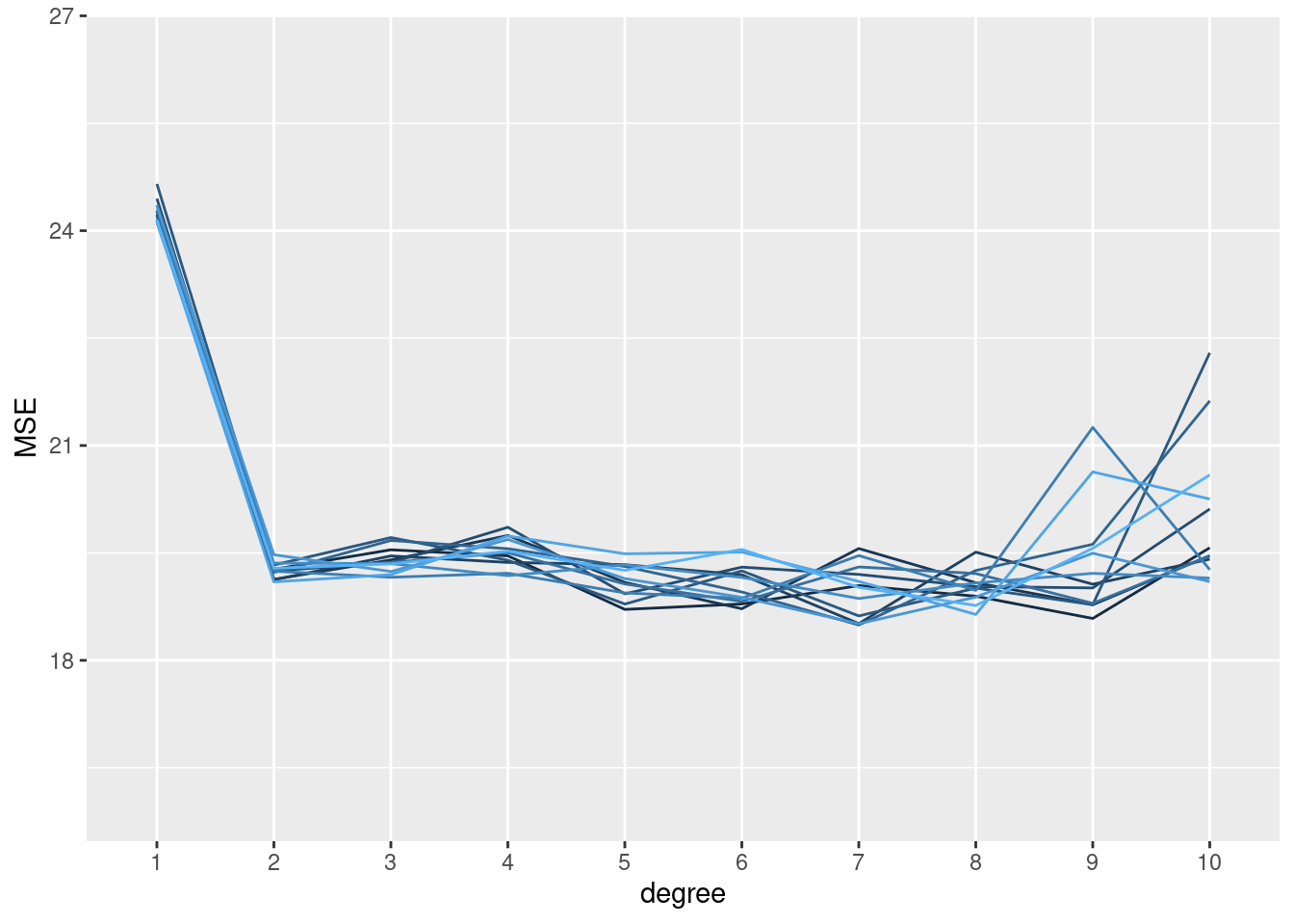
# 12 splits, 10 models
set.seed(1234)
replicate(n = 12, local({
  seed <- sample(1000, 1)
  sapply(1:10, function(x) mse_validset_lm(mpg ~ poly(horsepower, x),
                                           ISLR2::Auto, seed = seed))
})
) |>
  t() |> as.data.frame() |>
  setNames(1:10) |>
  dplyr::mutate(replication = 1:dplyr::n()) |>
  tidyr::pivot_longer(-replication, names_to = "degree", values_to = "MSE",
                      names_transform = forcats::as_factor) |>
  ggplot() + aes(x = degree, y = MSE, color = replication, group = replication) +
  geom_line(show.legend = FALSE) +
  ylim(16, 26.5)